
I love music! I guess that would be a given, seeing that I was a music major. I enjoy lots of different music and most other people do as well. But I've noticed that a lot of people seem to be intimidated by classical music, like they think they might enjoy it, if they only knew what to listen to. So, for today's Thursday Thirteen (and in honor of the fact that our music fix for the day, children's chorus, was canceled due to the tiny amount of snow we received) here are my personal favorites. Enjoy!
Thirteen Favorite Pieces for the Classically Clueless
1. Symphony No. 6 Pastorale (1808) by Ludwig van BeethovenA gorgeous symphonic depiction of a walk in the country- including a thunderstorm! My favorite of all the five moments is the fifth-
Shepherd's song. You can listen to excerpts of all the movements
here.
2. Overture to The Marriage of Figaro (1786) by Wolfgang Amadeus Mozart
This overture to Mozart's comic opera is short (4:49), fast and lots of fun!
3. Pictures at an Exhibition (1874) by Modeste Mussorgsky
This musical suite depicts several different
drawings and paintings (and rather strange ones, if you ask me) created by Victor Hartmann, a friend of the composer. Each "picture" is a musical depiction of one of Hartmann's works, and the final picture in the suite,
The Great Gate of Kiev (excerpt) sends chills down my spine! The suite was originally written for piano, but the orchestral setting by Maurice Ravel is most familiar.
4. Fanfare for the Common Man (1943) by Aaron CoplandThis brief piece was commissioned by the Cincinnati Symphony Orchestra during WWII as a musical contribution to the war effort. Copland later remarked,
“I sort of remember how I got the idea of writing A Fanfare for the Common Man -- it was the common man, after all, who was doing all the dirty work in the war and the army. He deserved a fanfare.” Scored for a brass ensemble, timpani and percussion, this fanfare gives me a thrill every time I hear it.
5. Prelude to An Afternoon of A Faun (1894) by Claude DebussyDebussy was the creator of French impressionism in music and this piece gives me the feeling of walking through one of Monet's ethereal landscapes. Debussy's
Clair de Lune (Moonlight) is also gorgeous.
6. The Planets (1916) by Gustav Holst
OK, Holst was a little weird and he had a peculiar fascination with astrology, which led to the composition of a suite of 7 works based on the planets (Earth was left out, and Pluto wasn't discovered yet, which, I suppose, is just as well...) Anyway, these pieces are great listening, and
Jupiter, the Bringer of Jollity is one of my favorite themes of all time. Here's another excerpt, from
Mars, The Bringer of War by the Dallas Symphony
7. 1812 Overture (1880) by Peter TchaikovskyThis unabashedly patriotic piece is often played at 4th of July celebrations across America, which probably leads many Americans to believe that it has something to do with the American War of 1812. In reality, the piece was written to commemorate the Russian victory over Napoleon's invading armies during the Napoleonic Wars (which eventually ended with Napoleon's defeat by the British at Waterloo). So why is it so popular in America? Because cannons are cool!
8. Trumpet Concerto in E flat (1796) by Franz Joseph Haydn Because I really like trumpet music. And the classical period. And this is the best of both!
9. Water Music (1717) by George Frederic Handel
Handel is baroque at its best! The
Water Music suite was commissioned by the King of England to accompany a ceremonial procession down the River Thames in 1717. Many of the themes will probably sound familiar; #10
Hornpipe is my favorite!
10. Polovtsian Dances (1869) by Alexander BorodinBorodin was a Russian doctor and scientist who wrote music in his "spare time".
Polovtsian Dances comes from a ballet sequence from his opera,
Prince Igor. Older people might be familiar with one of the themes because it was made into a Broadway song called
Strangers in Paradise. I've loved it ever since we played it for competition in my first year of Middle School Band.
11. Symphony No. 2 "Romantic" (1930) by Howard HansonA contemporary American composer, Howard Hanson described himself as a "neo-Romantic", and the themes in this beautiful symphony reflect all the drama and passion of the 19th century Romantic composers
12. Symphony No. 5 in C# Minor (1902) by Gustav MahlerMahler had the good fortune to have a name that begins with "M", meaning he often gets paired with
Mozart in symphony programs because
Mozart and Mahler has such a great ring to it. But I think Mahler is great all by himself! Just listen to this excerpt from the
Rondo-Finale...and turn up the volume!
13. Air on the G String from Orchestral Suite No.3 in D Major by Johann Sebastian Bach
J.S. Bach, who lived during the baroque period, is arguably the greatest composer in history. The Orchestral Suite No. 3 is one of his most famous works, due to the familiar second movement, nicknamed Air on the G String. Absolutely beautiful.

 I'm a bit... unconventional when it comes to housework, and I come by it honestly: I am my mother's daughter. My mother is the unashamed originator of the sock basket concept within our family, and I improved upon the idea, as outlined in my WFMW: The Sock Solution of three weeks ago. So when I had someone ask, "Where do you keep your sock basket?" I knew futher explanation might be required.
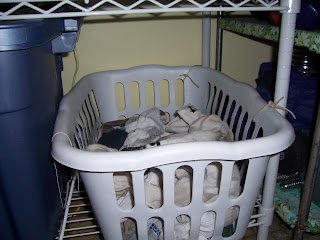 Yes, I have knotted that basket to the shelf. In three different places. Then I threatened to replace all the boys' white socks with pink and purple socks if I ever see clean socks on the floor again. And that works for me.


.JPG)


